
Wood, Light, and Time: Covered Bridges in Black and White
Why Black and White
Why or why not? To me, some images just ask me to make them Black and white. Covered bridges are a natural subject because they were built for function and not decoration.
Even though I created most of my covered bridge images in the last 20 years, once I make it black and White, its age becomes less apparent, because of the materials used to make the bridge, timbers from local sawmills and held together with treenails (or trenails), often pronounced and spelled as trunnels. The texture of the wooden frame just calls in many cases to be seen in B & W. (or sepia, but that is another article)
Black and white emphasize the light and shadows both inside and around the covered bridge.
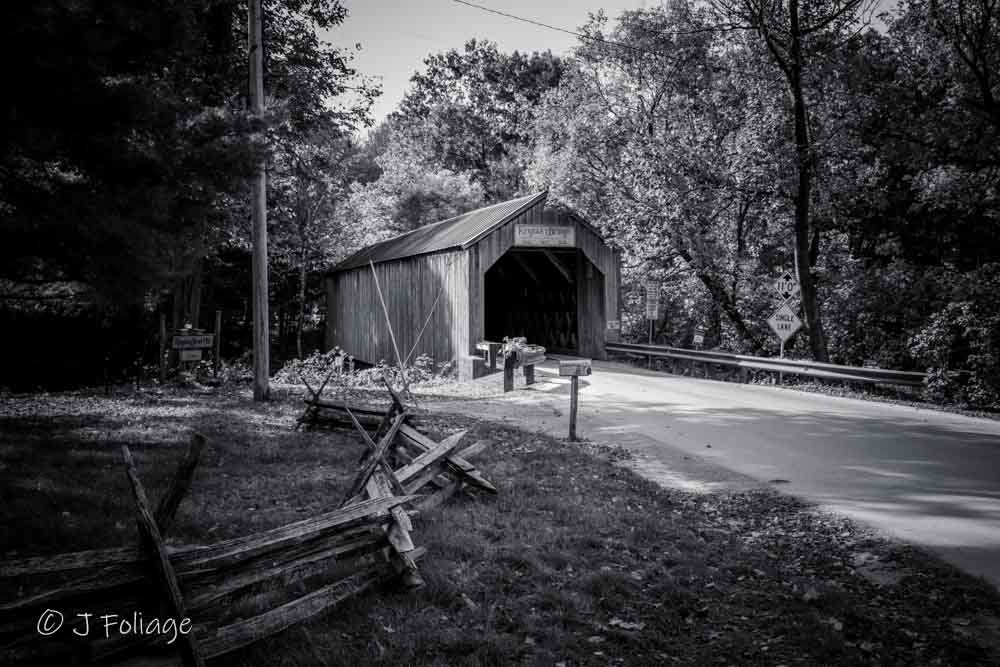
Kingsley Covered Bridge – Clarendon, Vermont
Why it works in B&W
First, the light falloff inside the bridge reads beautifully in monochrome. The aged wood feels natural without color. Also, the bridge easily separates itself from the nearby trees. My gallery of Vermont scenic images.
Photography notes
This was shot in late morning, and in October, the sun is still low over the hills. Shooting from this side of the bridge, you have lots of shadows that lend interest to the image. In particular, the Shadows on the dirt road keep your eyes busy, filling in the story in your mind.
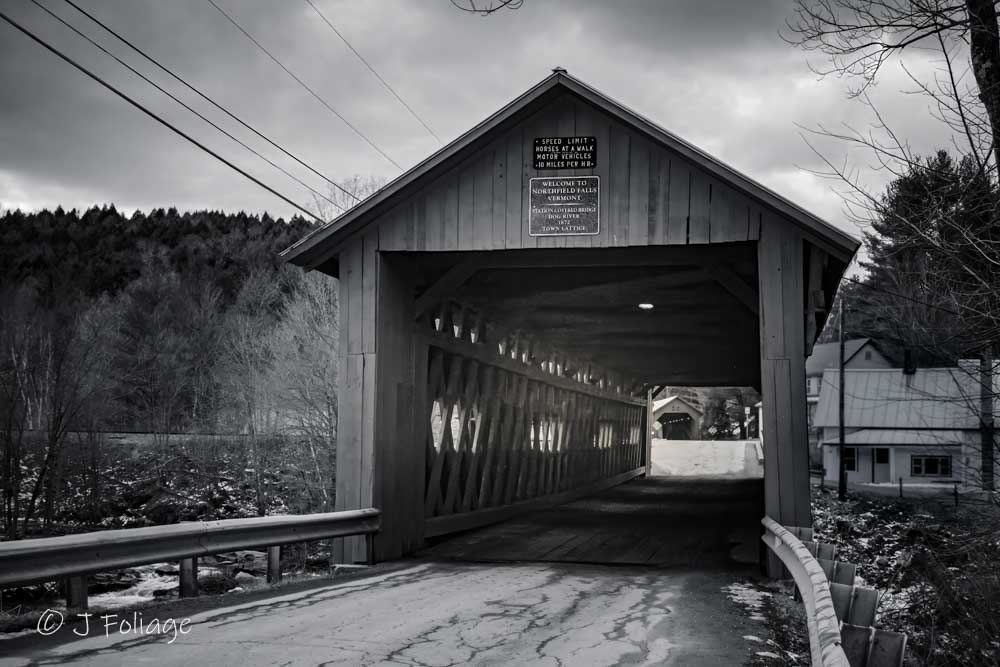
Station Covered Bridge – Northfield, Vermont
Why it works in B&W:
• The setting feels slightly removed, almost suspended
• Surrounding clutter disappears in monochrome
• Emphasizes the bridge as a passage rather than a landmark
Photography notes:
I actually got in a bit too close with this because I wanted to make apparent the fact that this is one of the two sets of covered bridges where you can see a second covered bridge from inside the first one.
I think these bridges work better in soft overcast light. A cloudy day will act as a soft, filtered light, filling in the shadows. I feel B&W focuses the image on just you, your camera, and the bridge.
I also have another article on the covered bridges in Montgomery, Vermont, here.
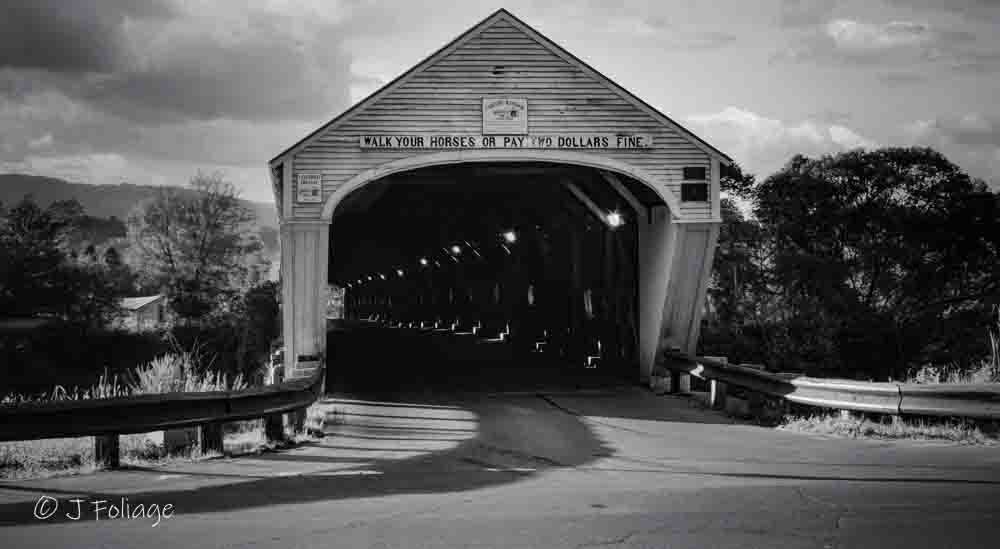
Cornish–Windsor Covered Bridge – NH / VT
Why it works in B&W
The Cornish-Windsor is the longest wooden covered bridge in the United States and the longest two-span covered bridge in the world. The 460 ft length makes it hard to focus on it and make intimate shots.
I think shooting it in B&W also removes seasonal bias. This shot was early Oct, but it could have been almost any month or decade. My gallery of New Hampshire scenic images.
Photography notes:
The light falls off on the inside quickly, but you can see the repeating wooden beams and the lights leading the eye through the bridge. B&W makes the bridge feel timeless rather than a tourist spot only.
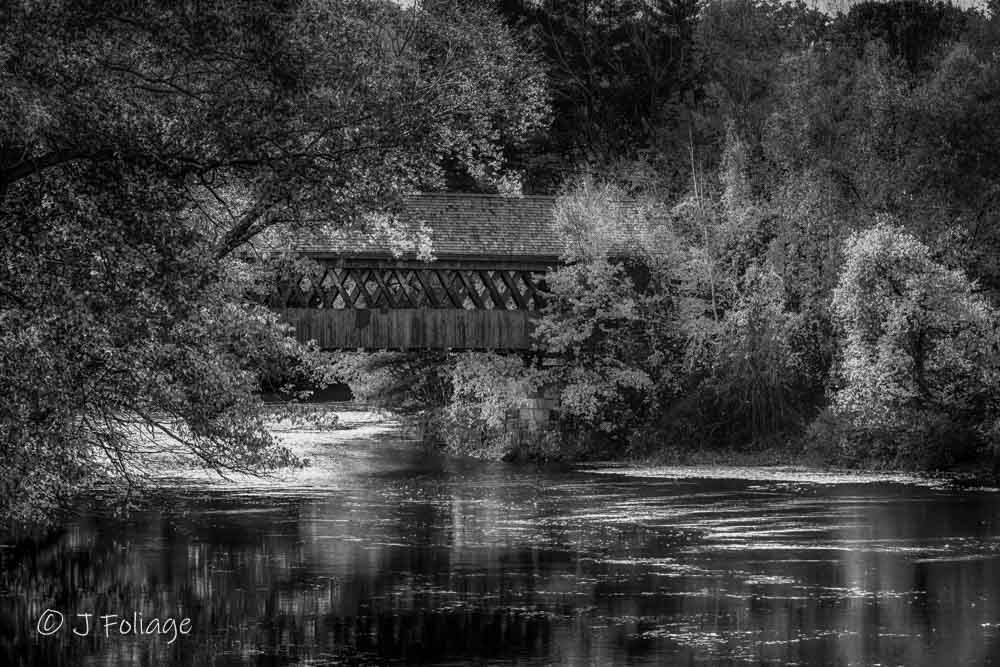
Henniker Covered Bridge – New Hampshire
Why it works in B&W
This shot of the Henniker Covered Bridge works well in color as well as B&W. There is something special about viewing it this way, almost intimate.
Photography notes:
You can shoot this bridge from many different angles. I was standing downriver on the stone bridge that carries actual traffic.
If you are part billy goat, you can climb down the far side of the stone bridge, and the portal underneath provides a wonderful frame for the wooden bridge. “Always put safety first when scrambling down riverbanks.”
(You can view examples in my gallery) I think the B&W really makes the bridge feel timeless.
When Color Stays (Cilleyville Bog)
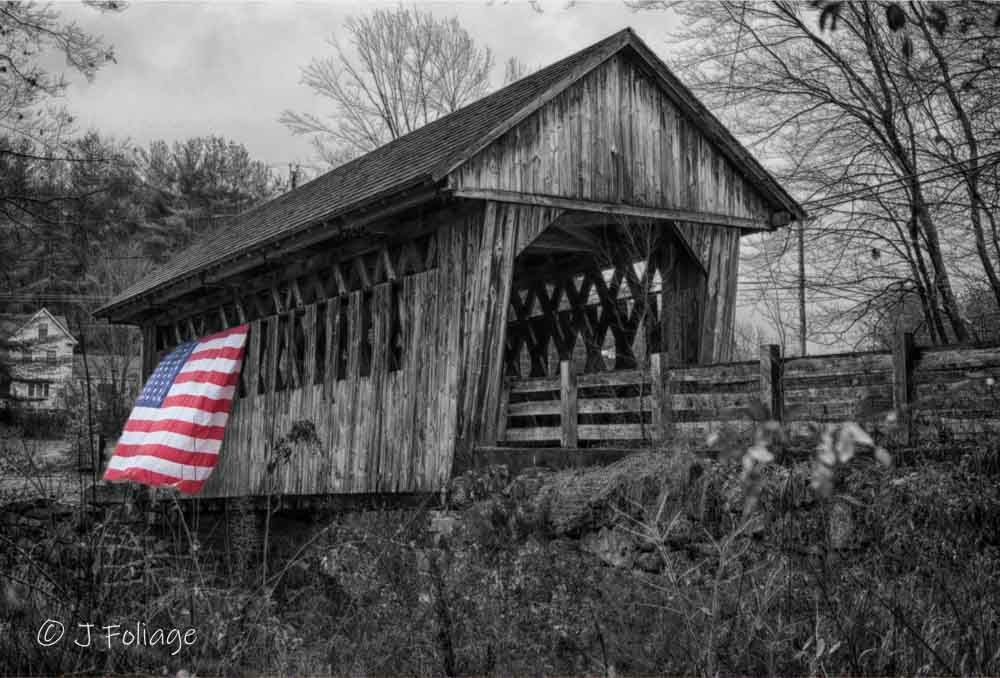
Why I made this selective color
It was a dreary day in late October, and the mood just suited a black and white image of a covered bridge. The Cilley Bog Bridge had one distinguishing factor: someone hung an American Flag from the middle of the bridge.
This really caught my eye, and I knew I had to make the flag stand out in post-production by letting the color lead the image. Having the flag there tells the story about American ingenuity and how we built these covered bridges across the country.
I chose to lead with selective color as emphasis, and not a gimmick. I think it really makes the image stand out.
Why Some Bridges Ask for Monochrome
Not everything works in Black and White and the inverse is also true. You will never see a one-for-one image creation in my gallery. What I mean is, I’m selective and I will never shoot a series of color shots and then just convert them all to B&W.
I think photographers who do this just aren’t listening to their images. They are in a hurry and don’t want to wait for the one or two images to speak to them.
To me, black and white isn’t nostalgia; it’s to focus on the subject of the image.
You will see in my gallery of currently 2,800 images, about 35 that have made the B&W cut. Also, I currently have 329 images of covered bridges, and only 6 have been made into B&W, plus one more is in Sepia.
Seeing Differently
These bridges have stood through generations of weather and change. Black and white doesn’t remove life from them. It lets their stories speak without interruption.
A small collection of these bridges in black and white can be found here.
“Do you have a favorite bridge that you think looks better in monochrome? Let me know in the comments below.”
Jeff “Foliage” Folger
You can purchase my images by visiting
Fine Art America for prints, home decor, and more
Join Jeff on his social media by clicking on any of the following.
On Bluesky at https://bsky.app/profile/jeff-foliage.com
On Instagram at https://www.instagram.com/jeff_foliage/
On Facebook at https://www.facebook.com/Vistaphotography/
Hi Jeff, of the six images you’ve featured from your Pixels website, I like the one with the flag the best — and not so much because of the flag (which I do think is a fabulous touch!) but because of the way the texture of the bridge is emphasized. It looks like a venerable old bridge, and the flag is somehow honoring that.
Thanks Nancy